what happens to a body after received by the funeral home
Upwards of 2.8 one thousand thousand people die every twelvemonth in the United States. Equally a funeral director who heads a university mortuary science programme, I can tell you that while each individual's life experiences are unique, what happens to a body afterward expiry follows a broadly predictable chain of events.
In full general, it depends on three things: where you lot die, how yous die and what yous or your family decide on for funeral arrangements and final disposition.
In death's immediate aftermath
Expiry tin can happen anywhere: at home; in a hospital, nursing or palliative intendance facility; or at the scene of an blow, homicide or suicide.
A medical examiner or coroner must investigate whenever a person dies unexpectedly while not under a dr.'south care. Based on the circumstances of the expiry, they determine whether an autopsy is needed. If and then, the body travels to a county morgue or a funeral domicile, where a pathologist conducts a detailed internal and external examination of the body equally well as toxicology tests.
Once the trunk can be released, some states let for families to handle the torso themselves, but most people employ a funeral director. The body is placed on a stretcher, covered and transferred from the place of expiry – sometimes via hearse, but more usually these days a minivan carries it to the funeral abode.
State law determines who has the authority to make funeral arrangements and decisions about the remains. In some states, you can choose during your lifetime how you'd like your body treated when you lot die. In most cases, however, decisions fall on surviving family or someone yous appointed before your death.
Preparing the body for viewing
In a 2020 consumer survey conducted by the National Funeral Directors Clan, 39.4% of respondents reported feeling it's very of import to have the body or cremated remains present at a funeral or memorial service.
To prepare for that, the funeral dwelling will unremarkably enquire whether the body is to be embalmed. This process sanitizes the trunk, temporarily preserves it for viewing and services, and restores a natural, peaceful advent. Embalming is typically required for a public viewing and in certain other circumstances, including if the person died of a communicable illness or if the cremation or burial is to be delayed for more than a few days.
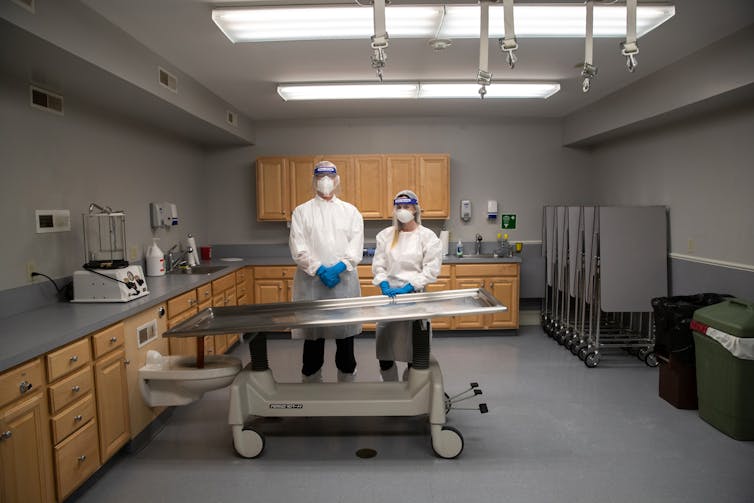
When the funeral director begins the embalming process, he places the body on a special porcelain or stainless steel table that looks much like what you'd detect in an operating room. He washes the torso with lather and water and positions information technology with the easily crossed over the abdomen, as you'd see them announced in a casket. He closes the eyes and oral cavity.
Adjacent the funeral managing director makes a small-scale incision almost the clavicle, to access the jugular vein and carotid artery. He inserts forceps into the jugular vein to let blood to drain out, while at the same time injecting embalming solution into the carotid avenue via a pocket-size tube continued to the embalming motorcar. For every 50 to 75 pounds of torso weight, it takes well-nigh a gallon of embalming solution, largely made up of formaldehyde. The funeral manager then removes backlog fluids and gases from the abdominal and thoracic cavities using an instrument called a trocar. It works much like the suction tube you lot've experienced at the dentist.
Next the funeral manager sutures any incisions. He grooms the hair and nails and again washes the body and dries it with towels. If the body is emaciated or dehydrated, he can inject a solution via hypodermic needle to plump facial features. If trauma or affliction has altered the appearance of the deceased, the embalmer can use wax, agglutinative and plaster to recreate natural grade.
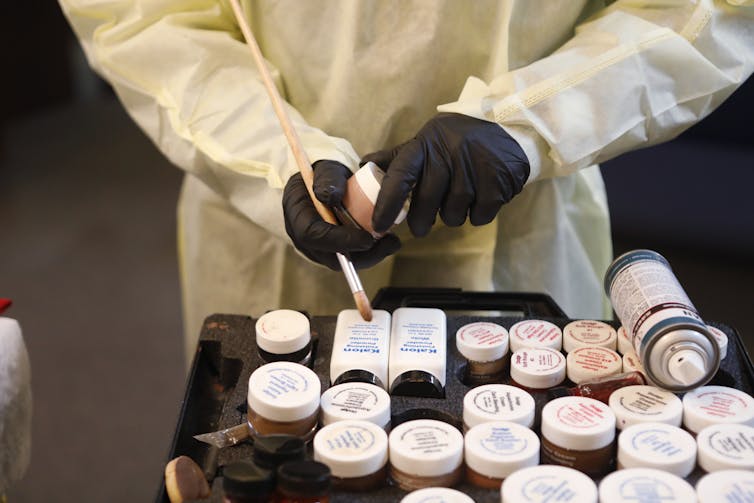
Lastly, the funeral director dresses the deceased and applies cosmetics. If the habiliment provided does not fit, he tin can cut it and tuck it in somewhere that doesn't show. Some funeral homes utilise an airbrush to apply cosmetics; others use specialized mortuary cosmetics or just regular makeup you might detect at a store.
Toward a concluding resting identify
If the deceased is to exist cremated without a public viewing, many funeral homes require a member of the family to identify him or her. Once the death document and whatever other necessary authorizations are complete, the funeral home transports the deceased in a called container to a crematory. This could exist onsite or at a third-political party provider.
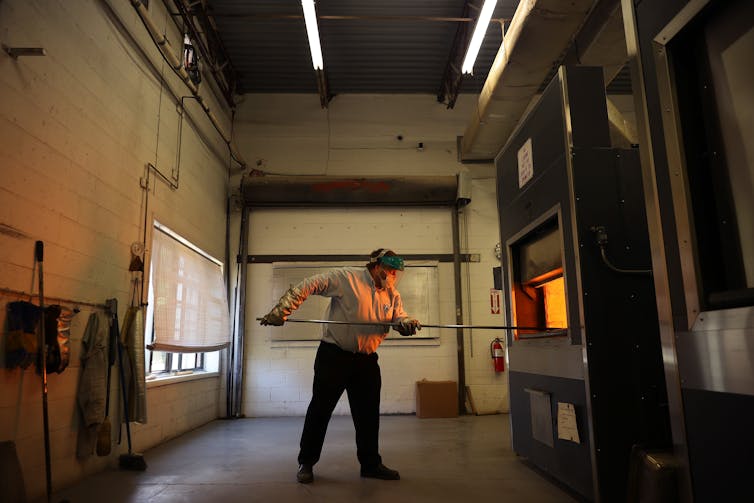
Cremations are performed individually. Still in the container, the deceased is placed in the cremator, which produces very high heat that reduces the remains to bone fragments. The operator removes any metal objects, like implants, fillings and parts of the casket or cremation container, and then pulverizes the bone fragments. He and so places the processed remains in the selected container or urn. Some families choose to proceed the cremated remains, while others bury them, place them in a niche or scatter them.
The year 2015 was the first yr that the cremation charge per unit exceeded the casketed burial rate in the U.S., and the industry expects that trend to continue.
When earth burying is chosen, the casket is usually placed in a concrete outer burial container earlier being lowered into the grave. Caskets tin as well be entombed in above-basis crypts inside buildings called mausoleums. Usually a grave or crypt has a headstone of some kind that bears the name and other details about the decedent.
Some cemeteries have spaces defended to environmentally witting "green" burials in which an unembalmed torso can exist cached in a biodegradable container. Other forms of final disposition are less common. As an alternative to cremation, the chemical procedure of alkaline hydrolysis can reduce remains to bone fragments. Composting involves placing the deceased in a vessel with organic materials like wood chips and straw to allow microbes to naturally break down the body.
[Deep knowledge, daily. Sign up for The Conversation'south newsletter.]
I've seen many changes over the course of my funeral service career, spanning more than 20 years then far. For decades, funeral directors were predominantly male, but now mortuary school enrollment nationwide is roughly 65% female person. Cremation has become more popular. More than people pre-program their ain funerals. Many Americans practice not have a religious affiliation and therefore opt for a less formal service.
Saying goodbye is of import for those who remain, and I have witnessed too many families foregoing a ceremony and later on regretting it. A dignified and meaningful adieu and the occasion to share memories and comfort each other honors the life of the deceased and facilitates healing for family and friends.
Source: https://theconversation.com/when-someone-dies-what-happens-to-the-body-143070
0 Response to "what happens to a body after received by the funeral home"
Post a Comment