The Conversations Walter Murch and the Art of Editing Film
| Walter Kurtz | |
|---|---|
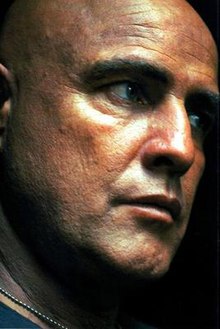 Marlon Brando equally Colonel Kurtz in Apocalypse Now | |
| First appearance | Apocalypse Now (1979) |
| Created past |
|
| Based on | Kurtz from Heart of Darkness |
| Portrayed past | Marlon Brando |
| In-universe information | |
| Alias |
|
| Gender | Male |
| Occupation |
|
| Spouse | Janet Kurtz |
| Children | 1 son |
| Nationality | American |
Colonel Walter Kurtz, portrayed by Marlon Brando, is a fictional graphic symbol and the main antagonist of Francis Ford Coppola's 1979 film Apocalypse Now. Colonel Kurtz is based on the graphic symbol of a nineteenth-century ivory trader, also chosen Kurtz, from the 1899 novella Heart of Darkness past Joseph Conrad.
Fictional biography [edit]
Walter Kurtz was a career officer in the United States Ground forces; he was a third-generation West Point graduate who had risen through the ranks and was seen to be destined for a acme post within the Pentagon. A dossier read past the narrator, Captain Willard, implies that Kurtz saw action in the Korean State of war after receiving a master's degree in history from Harvard University. He afterward graduated from the US Ground forces Airborne School.[1]
In 1964, the Articulation Chiefs of Staff sent Kurtz to Vietnam to compile a report on the failings of the current armed forces policies. His overtly disquisitional report, dated 3 March 1964, was not what was expected and was immediately restricted for the Articulation Chiefs and President Lyndon B. Johnson but.
On 11 May, 28 August, and 23 September 1964, 38-year-quondam Kurtz applied for Special Forces, which was denied out of hand because his historic period was too advanced for Special Forces training. Kurtz continued with his ambition and even threatened to quit the armed forces, when finally his wish was granted and he was allowed to accept the airborne course. Kurtz graduated in a class where he was about twice the age of the other trainees and was accepted into the Special Forces Training, and eventually into the 5th Special Forces Group.
Kurtz returned to Vietnam in 1966 with the Greenish Berets and was part of the hearts and minds campaign, which also included fortifying hamlets. On his adjacent bout, Kurtz was assigned to Project GAMMA, in which he was to enhance an army of Montagnards in and effectually the Vietnamese–Cambodian border to strike at the Viet Cong (VC) and North Vietnamese Regular army (NVA). Kurtz located his regular army, including their wives and children, at a remote abandoned Cambodian temple which Kurtz'south team fortified. From their base, Kurtz led attacks on the local VC and the regular NVA in the region.
Kurtz employed barbaric methods not only to defeat his enemy simply also to send fearfulness. At first Military Help Control, Vietnam (MACV) did non object to Kurtz'southward tactics, especially as they proved successful. This shortly changed when Kurtz allowed photographs of his atrocities to be released to the world.
In late 1967, subsequently Kurtz failed to reply to MACV's repeated orders to return to Da Nang and resign his control after he ordered the summary execution of four Due south Vietnamese intelligence agents whom he suspected of existence double agents for the Viet Cong, the MACV sent a Green Beret Captain named Richard Colby to bring Kurtz dorsum from Cambodia. Either because he was brainwashed or because he felt a sympathy towards Kurtz'southward cause, Colby joined up with Kurtz instead of bringing him back to Da Nang.
With Colby's failure, MACV then selected Captain Benjamin Fifty. Willard, a paratrooper and Regular army intelligence officer, to journey upwards the Nung river and kill Kurtz. Willard succeeded in his mission only because Kurtz, himself cleaved mentally by the barbarous war he had waged, wanted Willard to kill him and release him from his own suffering. Kurtz besides murdered Jay "Chef" Hicks past severing his head. Before Willard killed him, Kurtz asked Willard to find Kurtz's wife and son, and explain truthfully to them what he had done in the war.
Personality [edit]
Well, y'all come across Willard, in this state of war, things go confused out there: power, ideals, the old morality, practical military necessity. Only out there with these natives, it must be a temptation to be god, because there'southward a conflict in every human eye, between the rational and the irrational, between good and evil, and good does not always triumph. Sometimes, the dark side overcomes what Lincoln called the ameliorate angels of our nature. Every human has got a breaking bespeak. Y'all and I have ane. Walter Kurtz has reached his, and very obviously, he has gone insane...
—Lt. Gen. Corman describing Kurtz to Willard, Apocalypse Now (1979)
Always since he was in the The states Army, Kurtz was always a patriotic soldier for his nation, thinking on how to achieve victory in the Vietnam State of war by any kind of means. Seemingly a kindhearted homo, Kurtz eventually reached his "breaking point" co-ordinate to Gen. Corman's words. This signal led him to beguile the Us Army post-obit his dismissal, yet, he was a career-total soldier, fully serving his nation in any means. However, his breaking point led him to go a completely cold, psychopathic, maniacal and in a higher place all manipulative individual, aiming to apply his "unsound" methods to brand sure his nation would win the state of war, even though he was using those methods to brutally torture Vietnamese people, about to death, yet, he was not a sadist but a bold individual, using his boldness to ensure U.s.'s triumph. General Corman describes Kurtz to have originally been a good homo, the kind of person who is filled with kindness including the capability of seeing the departure between expert and evil.
Frequently ruthless, Kurtz has an extremely complex personality, that of which is near inexplainable. When he rose to power as the "God-King" of the Montagnards, Kurtz was treated truly like a godlike male monarch, using his extensive military training to form an army of followers and soldiers around him, eventually becoming a philosopher of state of war, reading poetry and quotes from the Holy Bible, leading him to be seen as truly insane.
The photojournalist "Jack" is the first American to meet Kurtz subsequently his transformation into a crazed megalomaniac, yet he describes him equally a great human, and, as a homo who reads poetry "out loud". His ruthless nature can be seen in photos presented to Willard, in which Kurtz had used his own men to kill or torture Vietnamese people, nonetheless, his truly ruthless nature comes to calorie-free when he tortures Willard physically by capturing him at a bamboo-like prison house booth, as well equally mentally by showing him the decapitated caput of his friend Chef, whom he had killed.
Inspiration [edit]
Colonel Kurtz is based on the character of a 19th-century ivory trader, too called Kurtz, from the novella Heart of Darkness (1899) by Joseph Conrad.
The picture's Kurtz is widely believed to have been modeled after Tony Poe, a highly decorated and highly unorthodox Vietnam War-era paramilitary officeholder from the CIA's Special Activities Sectionalisation.[two] Poe was known to drop severed heads into enemy-controlled villages equally a form of psychological warfare and to use human ears to record the number of enemies his indigenous troops had killed. He would send these ears back to his superiors as proof of his efforts deep inside Laos.[3] [4]
All the same, Coppola denies that Poe was a master influence. He maintains the character was loosely based on Special Forces Colonel Robert B. Rheault, whose 1969 abort for the murder of a suspected double agent generated substantial news coverage.[5]
Portrayal [edit]
Past early 1976, Coppola had persuaded Marlon Brando to play Kurtz, for a fee of $2 one thousand thousand for a month's work on location in September 1976. Brando also received 10% of the gross theatrical rental and 10% of the Television sale rights, earning him around $9 million.[6] [7]
When Brando arrived for filming in the Philippines in September 1976, he was dissatisfied with the script; Brando didn't understand why Kurtz was meant to be very thin and bald, or why the character's name was Kurtz and not something like Leighley. He claimed, "American generals don't accept those kinds of names. They have flowery names, from the South. I want to be 'Colonel Leighley'." And and so, for a fourth dimension the name was inverse under his demand.[8]
When Brando showed up for filming he had put on about 40 pounds (18 kg) and forced Coppola to shoot him above the waist, making it appear that Kurtz was a six-foot six-inch (198 cm) giant.[9] Many of Brando's speeches were ad-libbed, with Coppola filming hours of footage of these monologues and and then cutting them downward to the most interesting parts.[10]
Filming was put on a calendar week-long hiatus and so that Brando and Coppola could resolve their artistic disputes. It is claimed that someone left Conrad's source text, which Coppola had repeatedly referred to Brando but which Brando had never read, in the houseboat where Brando was staying at the time. Brando returned to filming with his head shaved, wanting to be "Kurtz" once again; claiming it was all clear to him now that he had read Conrad's novella.[11]
Still photographs of Brando in graphic symbol as Major Penderton, in the movie Reflections in a Gold Eye (1967), were used later by the producers of Apocalypse At present, who needed photos of a younger Brando to appear in the service record of the younger Colonel Walter Kurtz.[12]
As inspiration source [edit]
- Josh Brolin based his portrayal of the villain Thanos in the Marvel Cinematic Universe on Brando's portrayal as Kurtz.[xiii] [xiv]
- The character's appearance partially inspired that of Luke Skywalker in The Last Jedi (2017).[15]
- Portrayal of Vladimir Harkonnen in Dune (2021 film) was inspired by Brando's performance and the impression the graphic symbol makes.[16]
References [edit]
- ^ "Quotes for Captain Benjamin L. Willard (Character) from Apocalypse Now 1979". IMDb. 2014. Archived from the original on April ten, 2015. Retrieved September 30, 2014.
- ^ Leary, William 50. Death of a Fable. Air America Annal.
- ^ Warner, Roger (1996). Shooting at the Moon: The Story of America' Clandestine War in Lao people's democratic republic. South Royalton: Steerforth Press. ISBN1-883642-36-1.
- ^ Ehrlich, Richard S. (July 8, 2003). "CIA operative stood out in 'secret war' in Laos". Bangkok Post. Archived from the original on Baronial 6, 2009. Retrieved June 10, 2007.
- ^ Isaacs, Matt (November 17, 1999). "Agent Provocative". SF Weekly . Retrieved May 2, 2009.
- ^ "New York Sound Runway". Variety. Nov 21, 1979. p. 37.
- ^ Ascher-Walsh, Rebecca (July 2, 2004). "Millions for Marlon Brando". Entertainment Weekly. Archived from the original on August iii, 2020. Retrieved May xxx, 2020.
- ^ "Francis Ford Coppola: 'Apocalypse Now is not an anti-war film'". The Guardian . Retrieved February viii, 2022.
- ^ "Apocalypse At present Trivia". IMDB . Retrieved Feb two, 2018.
- ^ "Behind-The-Scenes Stories About Marlon Brando In 'Apocalypse Now'". Ranker.com . Retrieved February 8, 2022.
- ^ Ondaatje, Michael (2002). The Conversations: Walter Murch and the Art of Editing Film. London: Bloomsbury Publishing. pp. 68–69. ISBN978-1-4088-0011-nine.
- ^ "Reflections in a Aureate Center". Stylus Mag. Archived from the original on August 24, 2017. Retrieved February eight, 2022.
- ^ "Josh Brolin hints at Thanos' return and the inspiration for his Marvel flick office". www.digitaltrends.com . Retrieved January xi, 2020.
- ^ "Marvel: Josh Brolin To Channel Marlon Brando In Avengers Thanos Performance". International Business Times UK. August viii, 2014. Retrieved Jan 11, 2020.
- ^ Szostak, Phil (December 15, 2017). The Art of Star Wars: The Last Jedi. Abrams Books. p. 28. ISBN9781419727054.
- ^ "Dune Co-Costume Designer Bob Morgan Goes Back In Time For The Future [Interview]". Archived from the original on April 28, 2022.
Source: https://en.wikipedia.org/wiki/Colonel_Kurtz
0 Response to "The Conversations Walter Murch and the Art of Editing Film"
Post a Comment